
Designing with Light and Shadow: Integrating Shade Structures into Landscape Architecture
At the 2025 ASLA Conference in New Orleans, landscape architecture students gathered to network, celebrate their school spirit and learn about the latest industry trends. One of the key takeaways was the importance of incorporating shade within their projects.
For bachelor and master’s students in landscape architecture, understanding how form and function merge in shade design is essential – not just for comfort, but for storytelling, experiences and identity.
In the world of landscape architecture, where art and environment meet, light is one of the most powerful design tools. Yet, as much as light defines a space, so too does shadow. Thoughtfully integrating shade structures and sails into landscape plans transforms open areas from simple outdoor zones into functional, experiential and aesthetic environments.
The Function of Shade: Comfort, Climate, and Context
At the most practical level, shade structures mitigate one of the greatest challenges of outdoor design: sun exposure.
Whether in a park, a campus quad, a community plaza, or a recreation area, well-placed shade allows users to comfortably linger, socialize and interact within the space. Shade is not merely decorative; it is a health imperative – lowering temperatures, blocking UV rays and allowing more time to enjoy the great outdoors.
Apollo Sunguard’s shade canopies work like biomimicry, in which air easily passes through the canopy like the wind travels between the leaves of a tree. This results in 20 degree reduced ambient temperatures beneath.
The canopies also block up to 93% of UV rays, creating microclimates that encourage longer, more enjoyable use of outdoor environments without the concerns of skin cancer or premature aging.
With Apollo Sunguard’s shade structures over your landscapes, midday heat transforms into an invitation rather than a deterrent.
The Form of Shade: Sculptural Geometry and Dynamic Expression
Beyond their functional value, shade sails bring a sculptural, geometric quality to landscape compositions. Their forms – triangular, hyperbolic or custom-curved – interact with sun angles, creating an ever-changing interplay of light and shadow.
This dynamism introduces movement into the space, a visual rhythm that evolves throughout the day.
Unlike static built shade structures, tensile fabric designs allow for lightness and flexibility. Their minimal structural footprints make them ideal for preserving views, airflow and spatial openness – qualities prized in contemporary landscape design.
A single tensioned sail can both frame a view and define a zone, such as a picnic area, amphitheater or play space, while maintaining visual connection to the surrounding landscape.
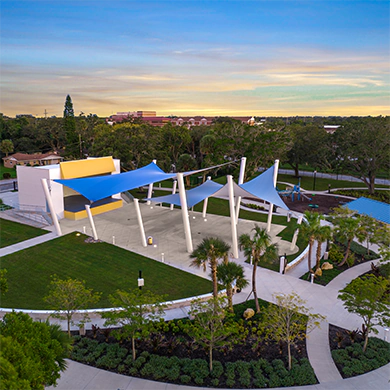 Apollo Sunguard’s shade sails at Daisy Stocking Park in Daytona Beach were designed to do just that – add spectacular shade to frame the amphitheater. Two stunning, large shade canopies connect at varying heights to large steel structures that run along the edge of the audience seating area, each installed at an outer angle. The canopies form a blanket over the audience, while the steel frames’ outward angle draws the eye to what is taking place on the stage.
The form-finding process – where tension, curvature and anchoring points determine the sail’s shape – mirrors the principles of responsive, adaptive design. Students can study these types of structures as expressions of environmental forces in balance: wind loads, sun paths and material elasticity all inform the final outcome. The result is a functional sculpture – a form that performs and inspires simultaneously.
Apollo Sunguard’s shade sails at Daisy Stocking Park in Daytona Beach were designed to do just that – add spectacular shade to frame the amphitheater. Two stunning, large shade canopies connect at varying heights to large steel structures that run along the edge of the audience seating area, each installed at an outer angle. The canopies form a blanket over the audience, while the steel frames’ outward angle draws the eye to what is taking place on the stage.
The form-finding process – where tension, curvature and anchoring points determine the sail’s shape – mirrors the principles of responsive, adaptive design. Students can study these types of structures as expressions of environmental forces in balance: wind loads, sun paths and material elasticity all inform the final outcome. The result is a functional sculpture – a form that performs and inspires simultaneously.
Enhancing the User Experience
Shade structures do more than shield; they choreograph experience. Consider how users move through a park. A sequence of shaded and open spaces can guide circulation, encourage gathering and create sensory contrast. Under the soft light of a shade sail, users perceive cooler air, quieter sound, and a greater sense of intimacy.
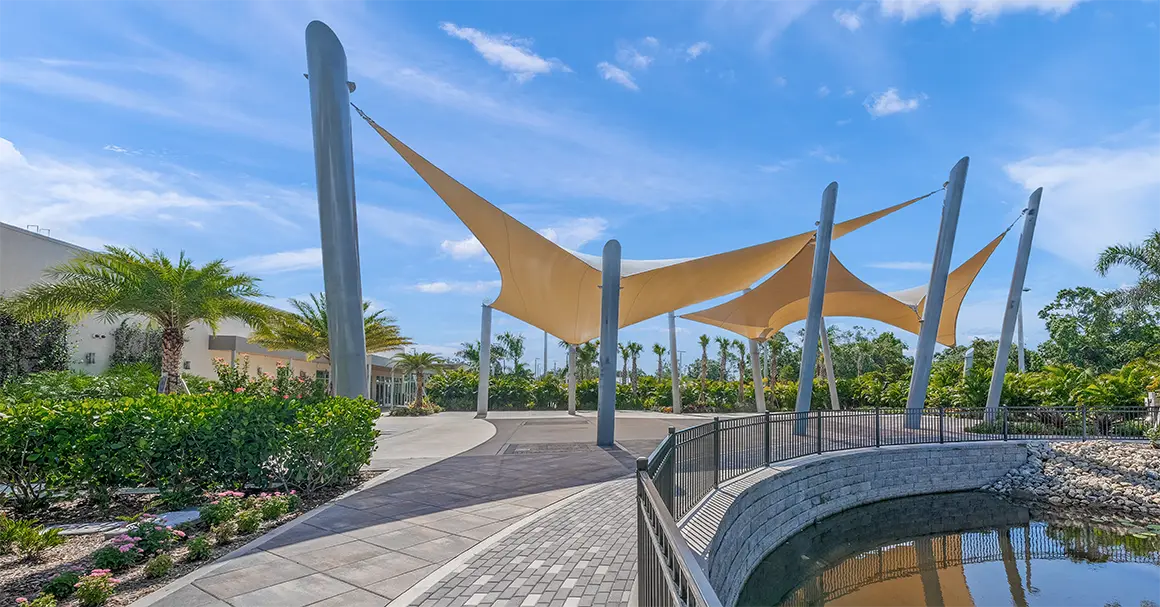
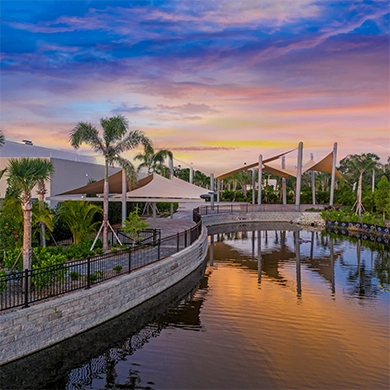 Apollo Sunguard’s shade structures at The Plaza, the outdoor patio area of The Ora in Sarasota, Florida, were designed to create a memorable experience beneath. With heights varying from 9 to 28 feet in the air, the steel structures and custom shade sails offer a breathtaking destination of its own within the 30,000-square-foot event center. “I wanted something that had a little bit of passion. I wanted something that evoked some emotion when you look at it,” said Ernesto De Oliveira, Chief Operating Officer and VP of Engineering for Apollo Sunguard.
In recreational areas or public plazas, the spatial rhythm between sunlight and shadow can become an experiential gradient – where activity levels, soundscapes and emotional tones shift from vibrancy to calm. Designers who understand this choreography can shape emotional journeys through their landscapes, enhancing both comfort and connection.
Apollo Sunguard’s shade structures at The Plaza, the outdoor patio area of The Ora in Sarasota, Florida, were designed to create a memorable experience beneath. With heights varying from 9 to 28 feet in the air, the steel structures and custom shade sails offer a breathtaking destination of its own within the 30,000-square-foot event center. “I wanted something that had a little bit of passion. I wanted something that evoked some emotion when you look at it,” said Ernesto De Oliveira, Chief Operating Officer and VP of Engineering for Apollo Sunguard.
In recreational areas or public plazas, the spatial rhythm between sunlight and shadow can become an experiential gradient – where activity levels, soundscapes and emotional tones shift from vibrancy to calm. Designers who understand this choreography can shape emotional journeys through their landscapes, enhancing both comfort and connection.
Branding and Identity: The Visual Language of Shade
Shade structures also provide opportunities for place branding and cultural storytelling. Through color, form and layout, shade sails can reflect institutional identity, community spirit or environmental themes.
A university might use its color palette subtly woven into shade designs over outdoor seating areas; a coastal town may echo the forms of sails and waves to reinforce its maritime identity – just as Apollo Sunguard’s shade sails did over a pirate-themed playground at Bayfront Park in Sarasota, Florida.
Frank Lloyd Wright’s philosophy – “form and function are one” – resonates strongly when it comes to creating visual landscapes. Wright believed that design should grow naturally from its environment, harmonizing with the site’s materials, colors and light. Applying this to shade design means choosing forms that belong: structures that rise organically from the landscape, complementing vegetation patterns, architectural lines and natural topography.
A shade sail over a desert courtyard might reflect the geometry of surrounding rock strata; a park pavilion might echo the canopy of nearby trees.
When branding and context are aligned, shade structures become part of the landscape’s narrative, not an afterthought. They can serve as wayfinding elements, focal points or visual anchors within a broader composition.
Designing with Purpose
For emerging landscape architects, incorporating shade structures is an opportunity to think holistically about climate, culture and human experience.
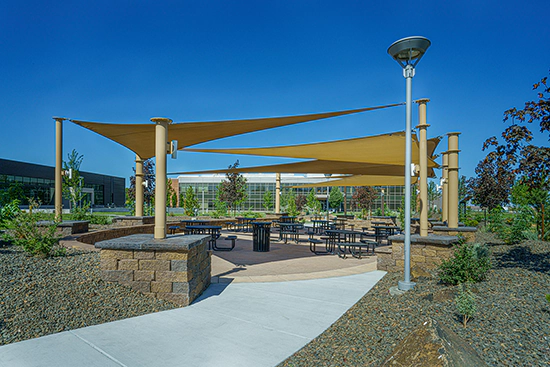 As you develop design concepts, consider shade not as an accessory, but as an architectural layer of its own: one that mediates between the sky and the earth, between heat and comfort, between utility and art.
Shade structures embody the principle that design can be both functional and poetic. In the hands of a thoughtful designer, a simple fabric stretched between points becomes a symbol of connection between people, place and the natural rhythms of light and shadow.
As you develop design concepts, consider shade not as an accessory, but as an architectural layer of its own: one that mediates between the sky and the earth, between heat and comfort, between utility and art.
Shade structures embody the principle that design can be both functional and poetic. In the hands of a thoughtful designer, a simple fabric stretched between points becomes a symbol of connection between people, place and the natural rhythms of light and shadow.
Apollo Sunguard specializes in custom commercial shade structures. With the strongest warranty in the industry – 15 years on the fabric and 20 years on the steel – Apollo Sunguard prides itself on offering the highest quality shades and a full design-and-build turnkey solution. Reach out to Apollo Sunguard to discuss your next shade project. Call 1-800-319-1010.